

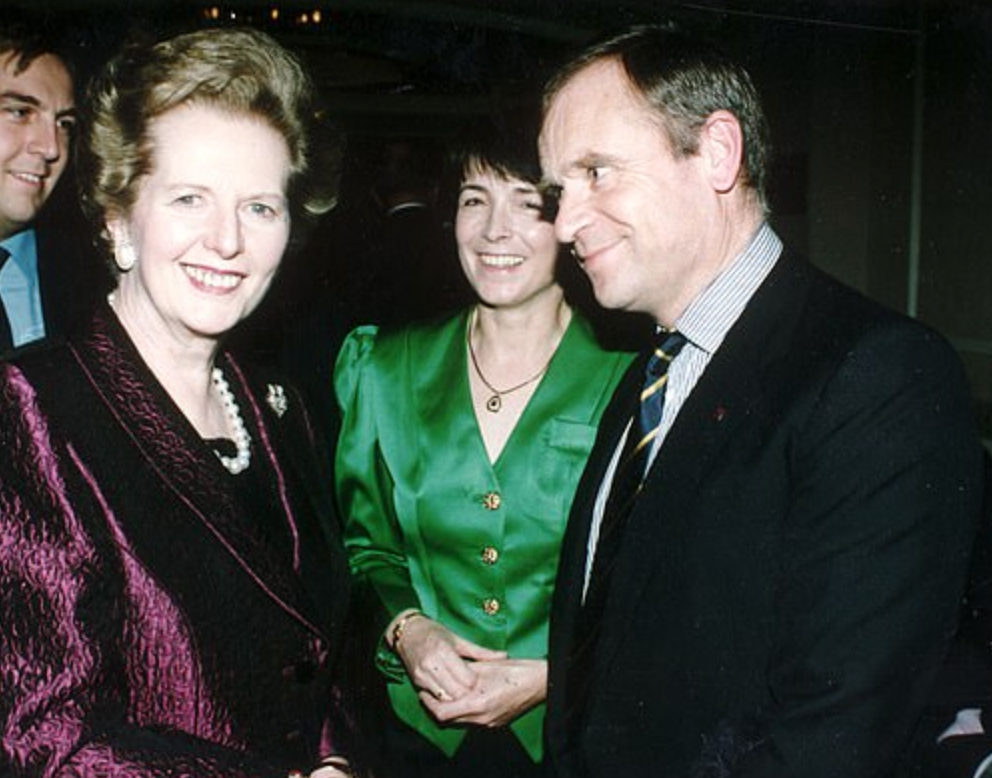
Jeffrey Archer, who died this week at the age of 86, lived the sort of life that, had he submitted it as the plot of one of his novels, an editor would surely have sent it back with a note: “Tone it down… nobody will believe this.”
Born to a single working-class mother, he became an accomplished athlete, a Member of Parliament before he was thirty, a millionaire who went spectacularly bankrupt and then reinvented himself as a bestselling novelist, a Conservative Party grandee, a member of the House of Lords, a candidate for Mayor of London, a convicted perjurer who ended up in prison — and then, somehow, bounced back as a bestselling novelist and treasured public figure all over again.
That was Jeffrey — whenever you thought the story was over, he turned the page and another one began.
I knew him for almost thirty years, and although the Jeffrey Archer I knew was certainly the same man who appeared so frequently in sensational newspaper headlines, he was also rather different from the caricature those headlines inevitably produced.
Our friendship began on one of the strangest mornings of my life. It was Sunday, August 31, 1997, and during the night, Diana, Princess of Wales, had died after the terrible crash in Paris. Britain woke up in total shock.
At the time, I presented the daily two-hour Jewish program on Spectrum Radio in London, and, like every broadcaster that morning, I was staring at an entirely redundant running order and wondering what on earth one could possibly say.
For reasons I can no longer remember, I thought of Jeffrey Archer. I didn’t really know him, but nevertheless, I found his telephone number, picked up the phone and called him. Remarkably, he answered himself.
Would he speak to our listeners about Diana? Would he share some memories of her on this bewildering Sunday morning, when it felt as though the whole world had suddenly stopped?
“Yes, of course,” he said. “Call me back in 15 minutes.” And that was how it began.
In retrospect, the spontaneity of his response was quintessential Jeffrey. He loved being where things were happening. He was constitutionally incapable of standing at the edge of events when he could be somewhere near — or preferably right in the middle of — them.
That telephone call was followed by others — many others. Those conversations became a relationship, and before long Jeffrey and I found ourselves embarked on something rather more mischievous, centered on the journalist and historian Max Hastings.
Hastings was then editor of London’s Evening Standard, and Jeffrey was convinced that Hastings loathed him and was out to get him. He wasn’t wrong. But Jeffrey was hardly alone. Hastings had another enemy in his sights: Bibi Netanyahu.
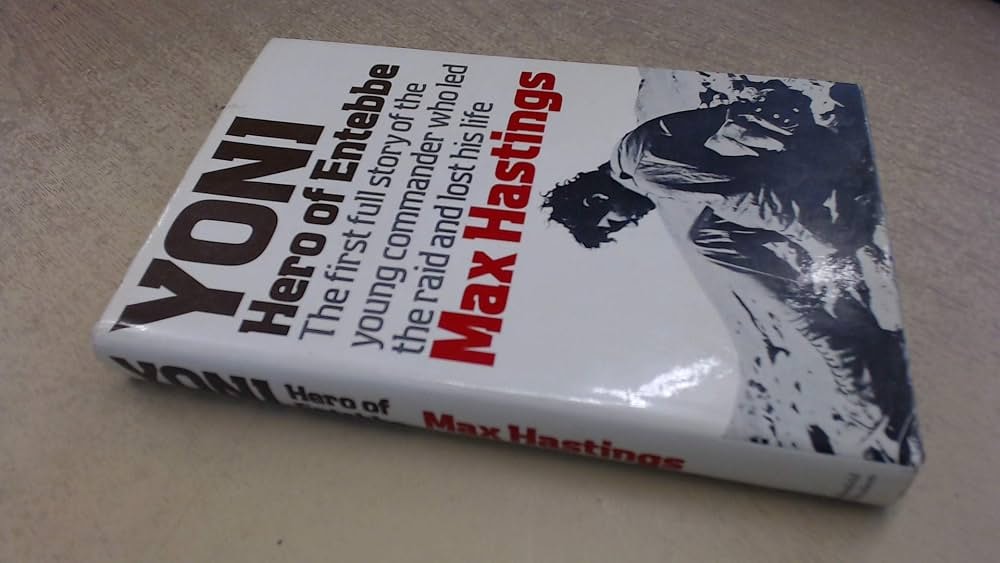
Hastings’s hostility toward Netanyahu was not really about Bibi himself, but about the Netanyahu family. Years earlier, the celebrated publisher George Weidenfeld had commissioned Hastings to write a book about Yoni Netanyahu, the legendary commander of the Entebbe rescue operation. The Netanyahu family was appalled by the resulting portrait.
Benzion Netanyahu, Yoni’s father, objected so furiously that although the book was eventually published — with edits approved by the family — the dispute left a bitterness that never disappeared. Hastings bore a grudge against the Netanyahus, and the Evening Standard — hardly a newspaper renowned for its international news coverage — became a convenient platform from which to snipe at Bibi, who was then, as now, Prime Minister of Israel.
Jeffrey believed that together we needed to tackle this menace — our interests converged in exposing what we regarded as Hastings’s less-than-objective approach to journalism.
In 1998, as Jeffrey’s mayoral ambitions gathered momentum, the Evening Standard resurrected a murky incident from Toronto in 1975 involving an allegation that he had taken suits from a department store. Unsurprisingly, Jeffrey was very angry, and so we began digging.
Going through press cuttings with Jeffrey Archer was an experience in itself. He approached them simultaneously as a politician preparing a case and as a novelist constructing a plot.
“What did he say before that?”
“Find the earlier clipping.”
“When did this appear?”
“Who spoke to whom?”
“What changed?”
“Why now?”
Jeffrey loved chronology because chronology revealed motive. Give him a grievance and within hours he had a dossier. Give him a dossier and very soon he had a story. And if there was one thing that Jeffrey always understood, it was the power of a story.
As our cooperation unfolded, somewhere along the way he asked me to help introduce him more broadly to London’s Jewish community as he prepared to seek the Conservative nomination for the newly created office of Mayor of London.
By then, I was rabbi of the Saatchi Synagogue. Saatchi was a rather unusual synagogue, created specifically for young Jewish professionals — singles and couples who were thoroughly immersed in London life but often found conventional synagogue culture somewhat less compelling. What they wanted was a Judaism, and a Jewish life, that spoke to them in their language and engaged with their interests, while remaining faithful to tradition and traditional values.
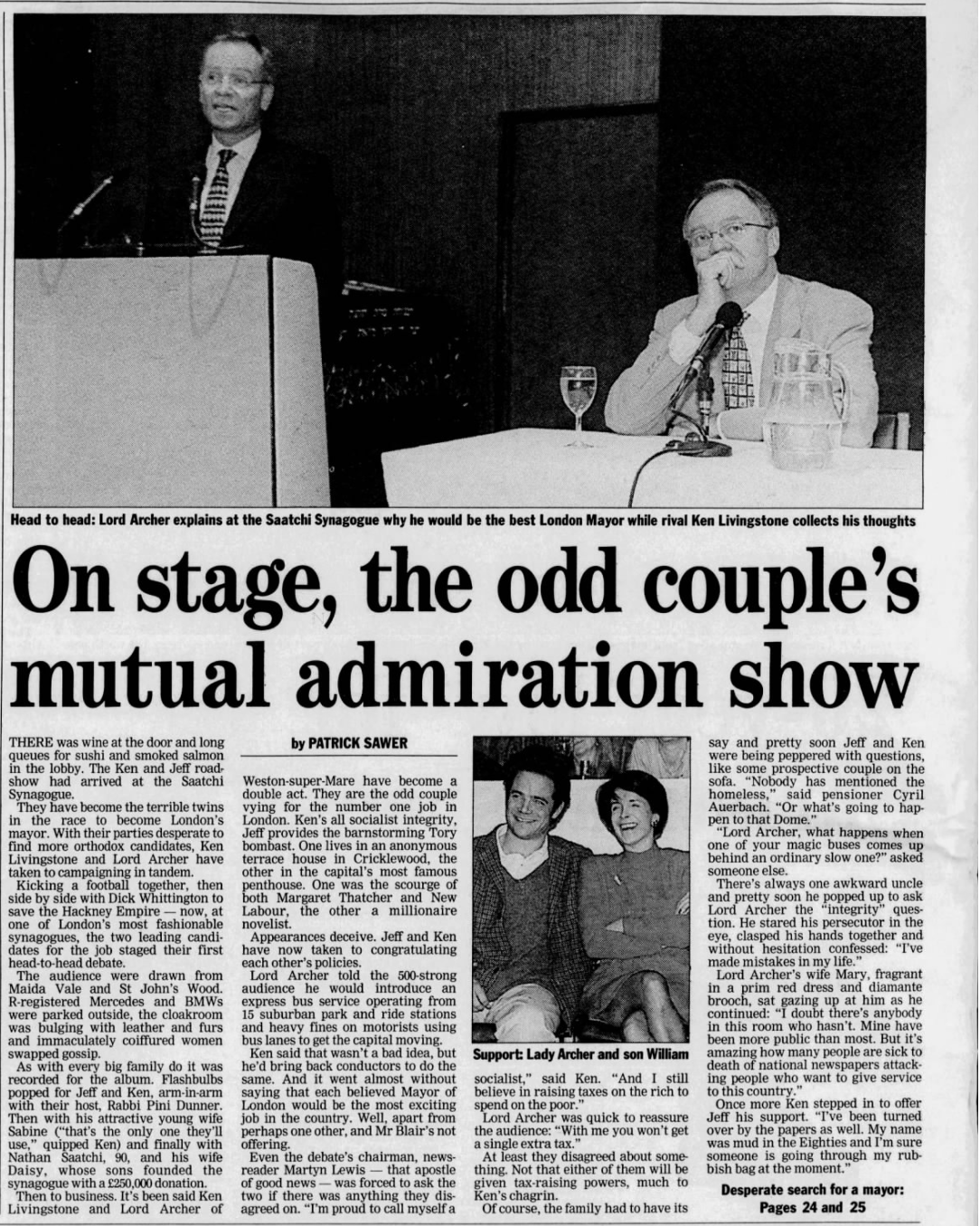
Which is how, in December 1998, I found myself putting Jeffrey Archer on a stage opposite the left-wing firebrand Ken Livingstone — whom I also knew from my Spectrum Radio days.
The two men were expected to become bitter rivals for the new mayoralty, and the debate attracted enormous attention. Five hundred people crammed into the synagogue. There were television cameras, journalists, political operatives, sushi, smoked salmon and — this being the Saatchi Synagogue in the late 1990s — an unusually high concentration of glamorous young Jewish professionals.
Everyone expected blood, but instead, Jeffrey and Ken – quite unexpectedly – rather liked each other. The following day, the Evening Standard splashed a photograph of the two of them across the page with the wonderful headline: “On stage, the odd couple’s mutual admiration show.”
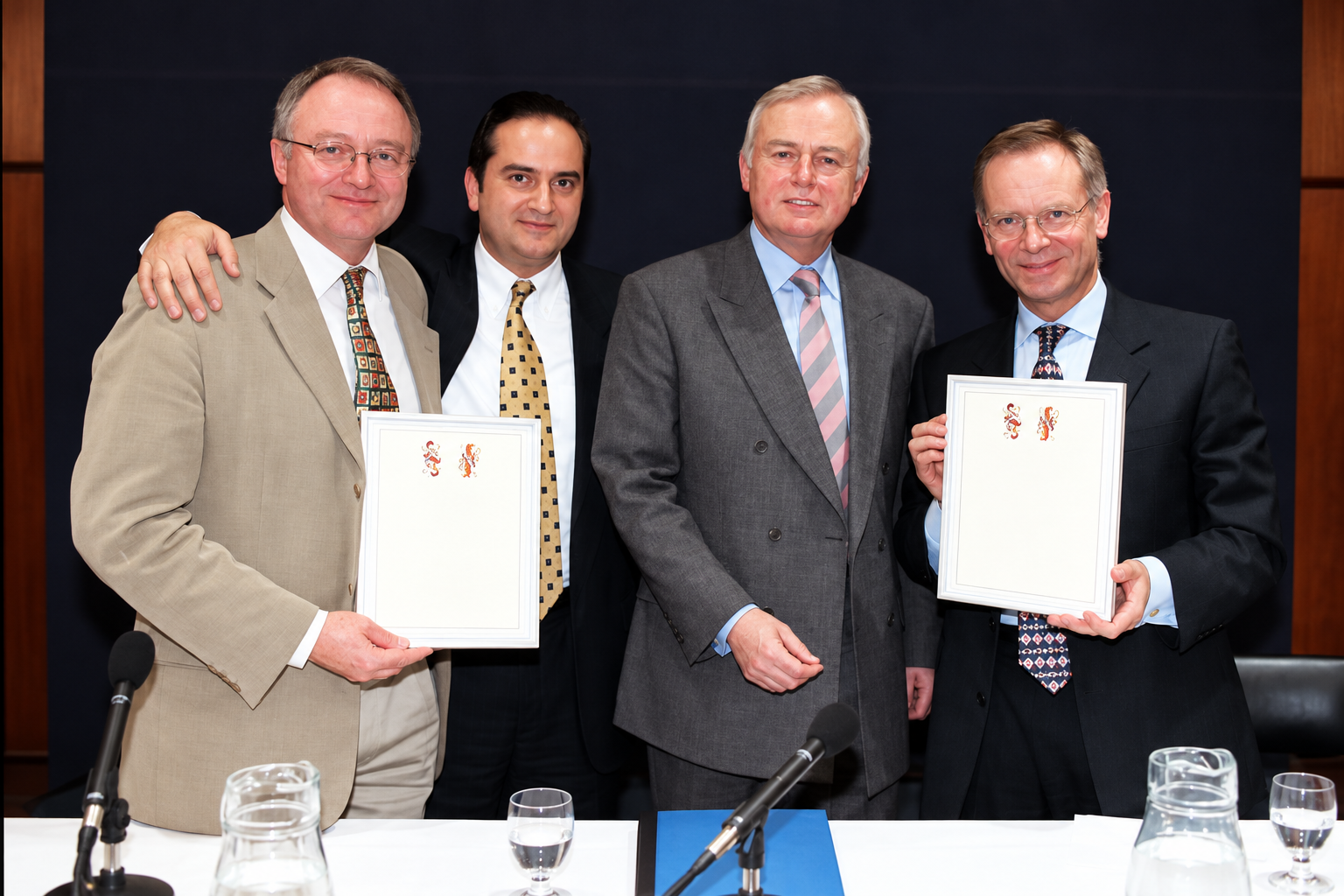
It was vintage Jeffrey. He loved an audience, he loved politics, he loved theatre, and he loved an opponent who could give as good as he got. But above all, he loved the intoxicating sense that something might happen next, and that he was part of it.
At that point, becoming Mayor of London was a very real prospect. Jeffrey had staged remarkable comebacks before. He had lost a fortune in the 1970s and reinvented himself as one of the world’s most successful novelists. He had resigned as Deputy Chairman of the Conservative Party amid scandal in 1986, and yet six years later had emerged as Lord Archer of Weston-super-Mare.
Now former prime ministers Margaret Thatcher and John Major were supporting him for Mayor of London. Jeffrey believed he was on his way back again, and, for a while, so did everyone else.
Less than a year after the Saatchi debate, I brought another mayor to Jeffrey and Mary’s famous two-story penthouse apartment on the Albert Embankment: Ehud Olmert, then Mayor of Jerusalem. The symbolism was irresistible. The Mayor of Jerusalem was standing in the home of the man who expected soon to be Mayor of London.
Olmert lectured Jeffrey: “The most important thing for any mayor to do is make sure the garbage is collected on time. If you leave garbage to fester, even your biggest supporters will end up as your enemies.”
Nothing about that event suggested impending catastrophe, but with Jeffrey, catastrophe was rarely far away, and within days, his political career imploded.
The very libel case that had helped rehabilitate him after the scandals of the 1980s came back to destroy him. And, in one of those coincidences that even Jeffrey might have hesitated to put into a novel, another close friend of mine was right in the middle of it. Stuart Kuttner, managing editor of Rupert Murdoch’s News of the World, was the man who met Jeffrey before publication — in that same Albert Embankment penthouse where we had held the Olmert event only days earlier — to tell him what the newspaper was about to reveal and to offer him the opportunity to respond.
Jeffrey immediately abandoned the mayoral campaign and the political dream was over. What followed over the next couple of years was considerably worse: arrest, charges of perjury and perverting the course of justice, prosecution, conviction — and a four-year prison sentence. It was a remarkable fall from grace.
Sabine and I visited him in prison. There he was, among criminals and gangsters, asking us to get him an egg sandwich from the vending machine in the visitors’ room.
This was the same man who had dined countless times with the Queen and hosted prime ministers at his home. The same man who, not long before, had stood before hundreds of people asking them to imagine him governing London. And now he wanted an egg sandwich from a prison vending machine.
I have never tried to sentimentalize why Jeffrey was there — he had committed serious offences, and had been found guilty by a jury of his peers. Friendship does not overturn a jury verdict. But friendship does change the way one sees the person found guilty of a crime.
The newspapers saw Lord Archer, convicted perjurer. I saw that man too. But I also saw the man who had taken my unexpected telephone call on the morning Diana died, and generously given his time to someone he had never met. The man with whom I had pored over newspaper cuttings as we tried to prevent what we regarded as false journalism from making its way into the mainstream press. The man I had watched sparring with Ken Livingstone at a packed event at my synagogue. The man whose home had been filled with political promise only shortly before everything collapsed.
That is one of the peculiar privileges — and complications — of friendship. The public remembers the controversial episodes. Friends remember the real person between them.
And Jeffrey, being Jeffrey, turned even prison into material. He wrote three volumes of prison diaries: Hell, Purgatory and Heaven. Somehow, he managed to send me signed copies from prison, personally inscribed to “Pini and Sabine… Jeffrey Archer.”
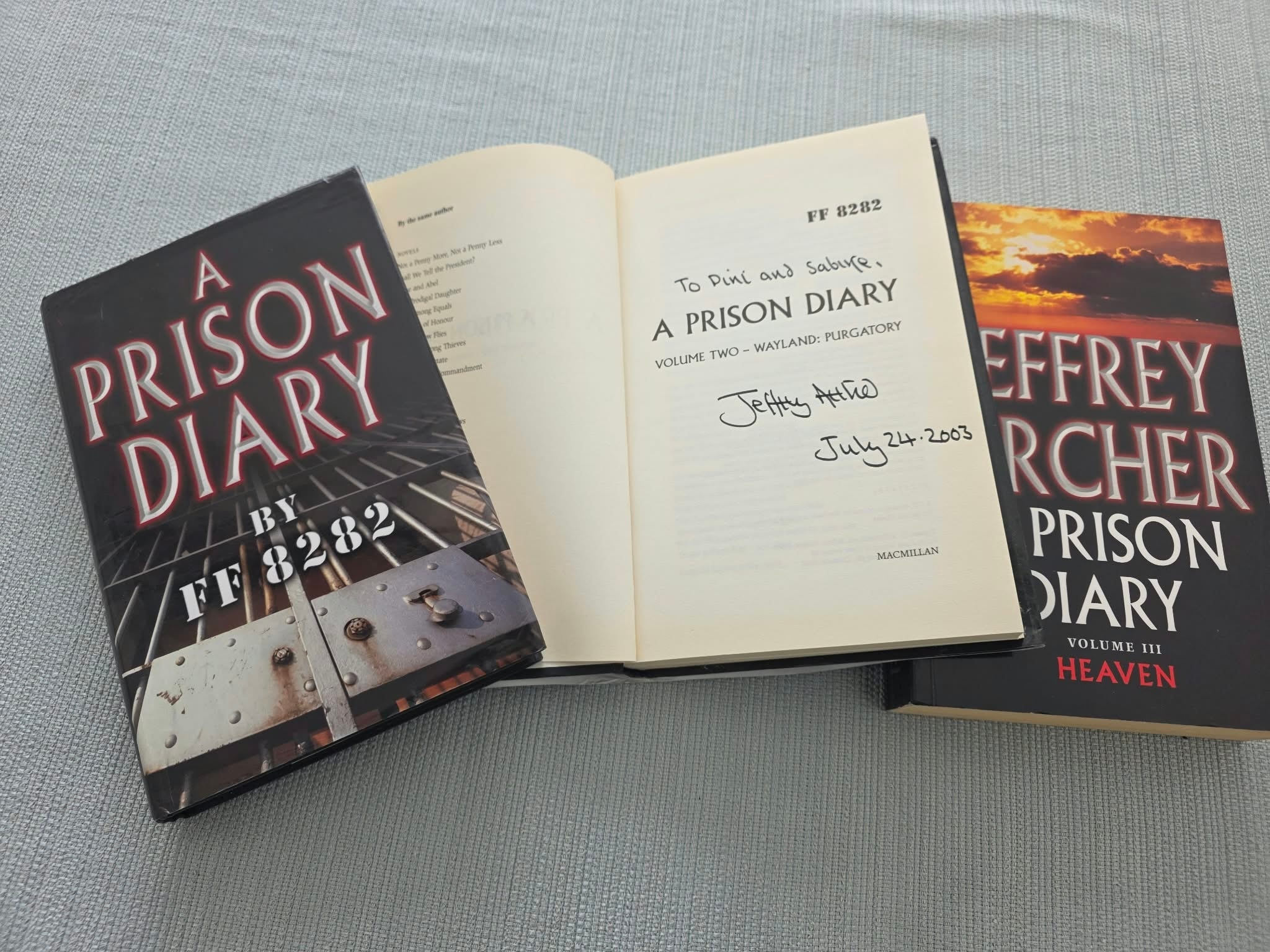
They were superbly written and became instant bestsellers, because whatever else one could say of Jeffrey Archer — and there is plenty to say — the man could certainly tell a good story. The literary establishment could be sniffy about him, but he didn’t care a jot. Millions upon millions of readers around the world disagreed and they kept buying his books.
After prison, our friendship resumed much as before. I returned to the parties at the Albert Embankment, where Jeffrey and Mary always made sure that kosher food was specially brought in for me.
I have never forgotten that. It sounds almost trivial beside the grand dramas of Jeffrey’s life, but perhaps that is precisely why I remember it. Amid the politicians, celebrities, champagne and noise, someone had remembered beforehand that the rabbi needed something different to eat.
Those parties were extraordinary. At one of them, I somehow found myself sitting on a sofa beside Lady Thatcher. Just the two of us, chatting. For several wonderful minutes, I had the undivided attention of the woman who had dominated British politics throughout my youth. Only at Jeffrey Archer’s Christmas party could this somehow feel entirely normal.
At another, the renowned Shakespearean actor Sir Donald Sinden held court and told some of the most gloriously improbable stories I have ever heard. He did not merely tell an anecdote — he performed it. Every pause, every raised eyebrow, every change of voice was perfectly calibrated.
Jeffrey adored people like that. He collected characters. That, more than celebrity itself, was what interested him. He wanted people who had been somewhere, seen something, knew someone, or possessed a story nobody else in the room had heard.
After I moved to Los Angeles, we remained in touch, usually by email and very often through Jeffrey’s indomitable personal assistant Alison Prince. Anyone who knew Jeffrey knew Alison. To describe her merely as his assistant rather understates the matter. She was mission control. Jeffrey lived at several hundred miles an hour, and Alison somehow kept the aircraft in the sky.
Alison’s sudden death from cancer in 2023 saddened me enormously. One of the permanent fixtures of the Jeffrey Archer world had disappeared. And now Jeffrey has disappeared too.
When I heard the news, a torrent of memories came rushing back: Diana. Spectrum Radio. Max Hastings. The newspaper cuttings. The Saatchi Synagogue. Ken Livingstone. Ehud Olmert at the Embankment. The collapse of the mayoral campaign. Prison. The signed books. The parties. The kosher food. Lady Thatcher on the sofa. Donald Sinden telling stories. Alison making everything happen.
Jeffrey Archer’s contradictions were enormous. He could be reckless, combative and astonishingly certain of his own righteousness. He made grave mistakes and paid a terrible price for some of them. But none of that requires me to pretend that the man I knew did not also possess warmth, charm, generosity, curiosity and an extraordinary capacity for loyal friendship.
Human beings inconveniently refuse to fit into the neat categories we create for them, and Jeffrey was that rule personified. The convicted perjurer was also the man who remembered that a rabbi needed kosher food. The famous peer and bestselling author was also the man who personally answered a stranger’s telephone call on the morning Diana died. The man whose ambition repeatedly led him toward disaster was also a writer with an almost supernatural instinct for keeping readers enthralled. One fact does not cancel the other.
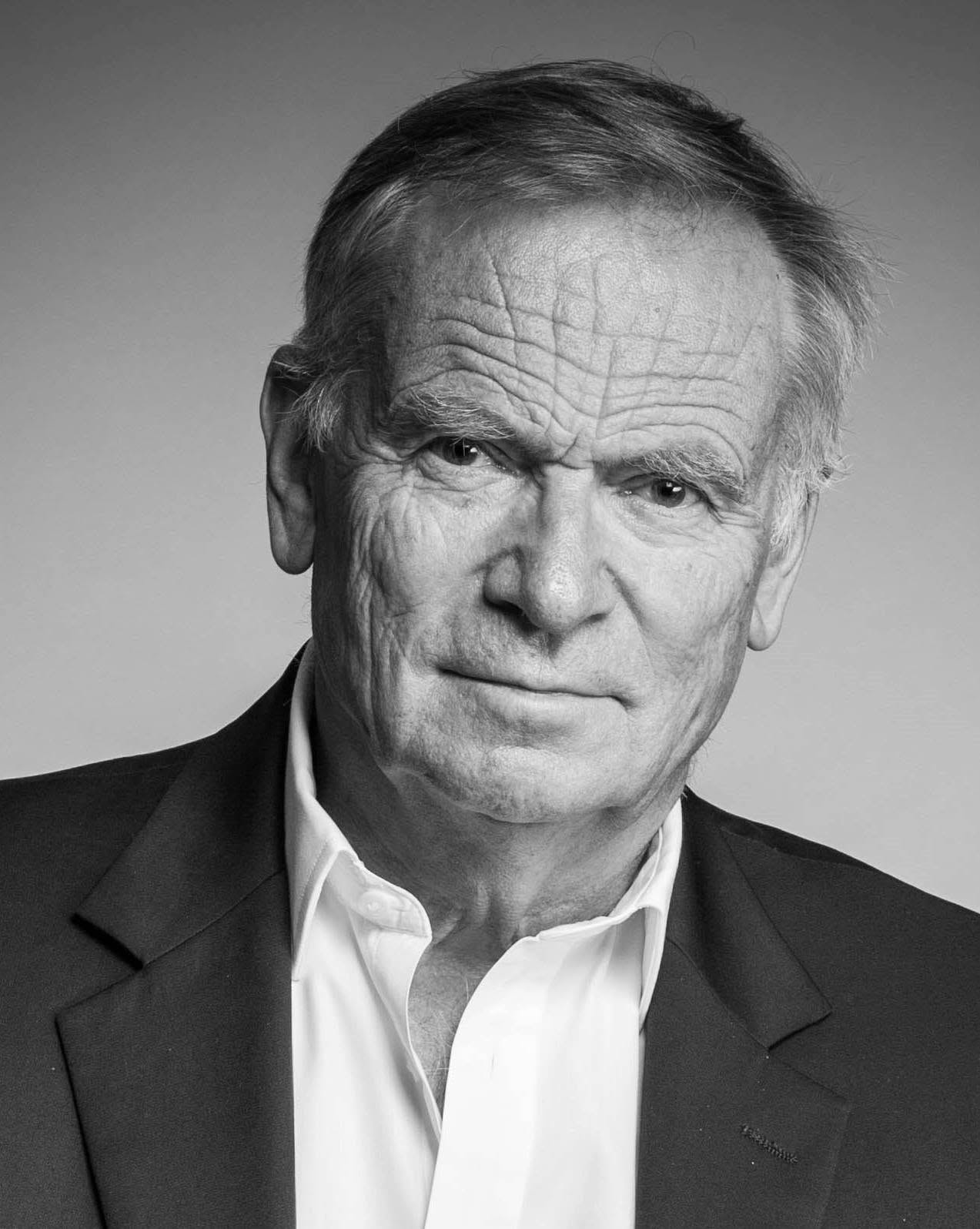
When I wrote to Mary and to Jeffrey’s son Will after hearing of his death, I told them that I felt extraordinarily fortunate to have known him, and that above all I remembered his warmth, his generosity of spirit, his extraordinary energy and the affection he showed me personally. I meant every word.
Jeffrey spent his life turning experience into stories. In the end, his own life became the most improbable Jeffrey Archer story of them all. I was fortunate enough to appear in a few chapters, and I will always remember him with tremendous affection.
May his memory be a blessing.